WHEN YOUR VERY FIRST MEAL IS YOUR SIBLING
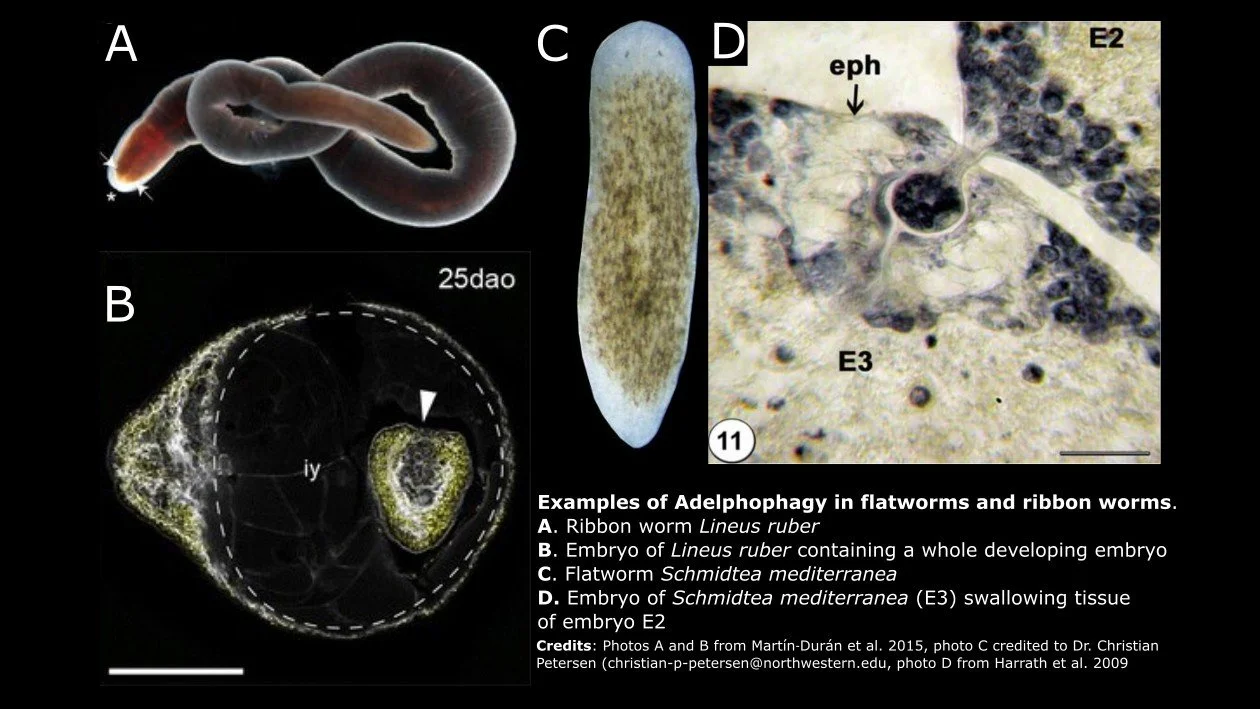
Nature never stops amazing us with the incredible diversity of parental strategies that have evolved to increase offspring survival. During development, mothers provide nutrients to their young in different ways, usually through a placenta, maternal tissues, or yolk stored in the egg. But, can you believe that there is an extreme case in which the food that mothers provide is the siblings that are sharing the same maternal space? This phenomenon, known as adelphophagy, is relatively rare in the animal kingdom, but has been documented in vertebrates such as sharks, as well as in invertebrates like echinoderms, insects, molluscs, and annelids.
Maternal feeding of siblings also occurs in two types of invertebrates that are unfamiliar to many of us: flatworms and ribbon worms. Both are soft-bodied invertebrates with worm-like bodies; however, they are not true worms. Flatworms belong to the phylum Platyhelminthes, whereas ribbon worms are mostly marine, predatory organisms in the phylum Nemertea.
Martín‐Durán and colleagues (2015) used molecular approaches to demonstrate that the larvae of the ribbon worm Lineus ruber actively feed on both unfertilized eggs and developing siblings. Remarkably, they saw larger individuals that had ingested another developing and apparently viable whole embryo. Ingestion of siblings began before metamorphosis and continued up until post-metamorphic juveniles left their egg string. In 2009, Harrath and colleagues documented adelphophagy for the first time in the planarian Schmidtea mediterranea. In histological slides, they observed some embryos ingesting tissues of adjacent sibling embryos. They could not discern whether entire embryos were consumed or only fragments of tissue. However, many more eggs were deposited in a cocoon than the number of juveniles that eventually hatched, which supports the hypothesis that siblings are consuming whole embryos.
Adelphophagy is remarkable, and a little weird, but it provides valuable insight for comparing early developmental competition and life history strategies across animals. It is rather difficult to study in detail due to the challenges of observing and testing these interactions directly, but further research will be essential to clarify under which ecological or evolutionary factors adelphophagy evolves.
Sources:
Harrath A, Sluys R, Zghal F & Tekaya S. 2009. First report of adelphophagy in flatworms during the embryonic development of the planarian Schmidtea mediterranea (Benazzi, Baguñà, Ballester, Puccinelli & Del Papa, 1975) (Platyhelminthes, Tricladida). Invertebrate Reproduction & Development 53(3), 117–124. https://doi.org/10.1080/07924259.2009.9652297
Martín-Durán JM, Vellutini BC & Hejnol A. 2015. Evolution and development of the adelphophagic, intracapsular Schmidt’s larva of the nemertean Lineus ruber. EvoDevo 6, 28. https://doi.org/10.1186/s13227-015-0023-5