IS THE HEALTH OF THE OFFSPRING REALLY ONLY THE MOTHER’S RESPONSIBILITY?
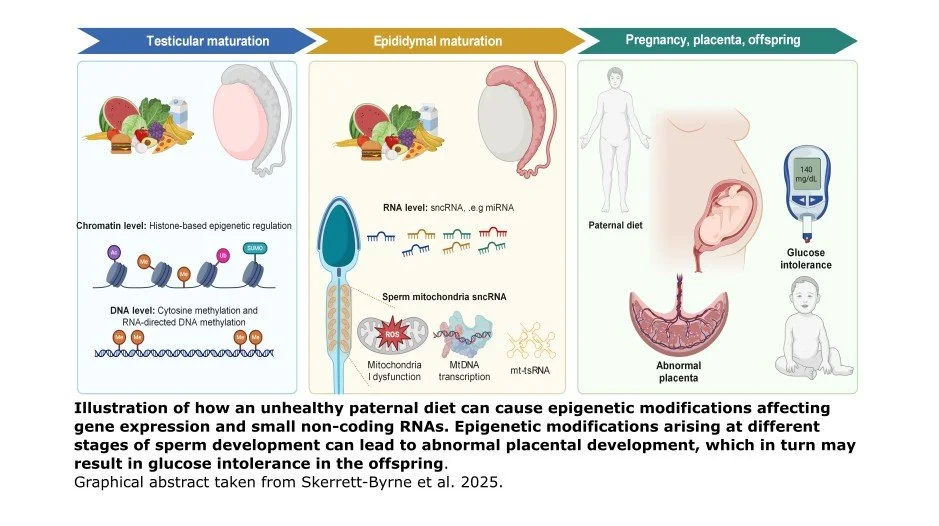
Decades of research have been dedicated to link the mother’s health and nutritional habits with the health of their children in both the short and the long term. And yes, it is important of course! However, what do we know about the effect of the father’s nutritional habits? Is the father’s only job really to contribute sperm to fertilize the egg? In short, the answers are “yes” and “no”. Yes, because the nutritional habits of the father also affect the offspring. And no, because the sperm does not only contribute genetic material, but also play a fundamental role in fetal and child development.
In an elegant review, Skerrett-Byrne and colleagues (2025) remind us that sperm is far from being only a passive DNA carrier, but rather is an epigenetically active player. The epigenome can be thought of as a set of chemical tags that dictate gene expression, turning different genes on and off. In their review, the researchers point out that sperm can acquire epigenetic information, driven by environmental and dietary stressors. They highlight evidence that shows how a high-fat-diet (HFD) causes epigenetic changes in fathers’ sperm that in turn alter the expression of genes and small non-coding RNAs. These changes are implicated in placental and embryonic development, as well as metabolic disease susceptibility in offspring after birth.
The review goes a step further by introducing an interactive digital application, ShinySpermPlacenta, designed to facilitate open-access exploration of the paternal epigenetic data. Users can explore the overlap between HFD sperm epigenetic data and placenta phenotype-driven genes. The app aims to promote systems-level understanding of how preconception environments shape the next generation.
Although the research on the transgenerational effects of paternal nutrition is still new compared to research on maternal nutrition, the growing body of evidence is substantial. Skerrett-Byrne and colleagues highlight the need to reframe preconception care as a truly bi-parental responsibility, rather than placing the entire burden on mothers. This fresh perspective could improve fertility and reduce pregnancy complications and chronic disease in our society.
Source:
Skerrett-Byrne DA, Pepin AS, Laurent K, Beckers J, Schneider R, de Angelis MH & Teperino R. 2025. Dad’s diet shapes the future: How paternal nutrition impacts placental development and childhood metabolic health. Molecular Nutrition & Food Research, 0:e70261. https://doi.org/10.1002/mnfr.70261