WHEN ANTS GET CLOSE…WHAT DO THEY EXCHANGE?
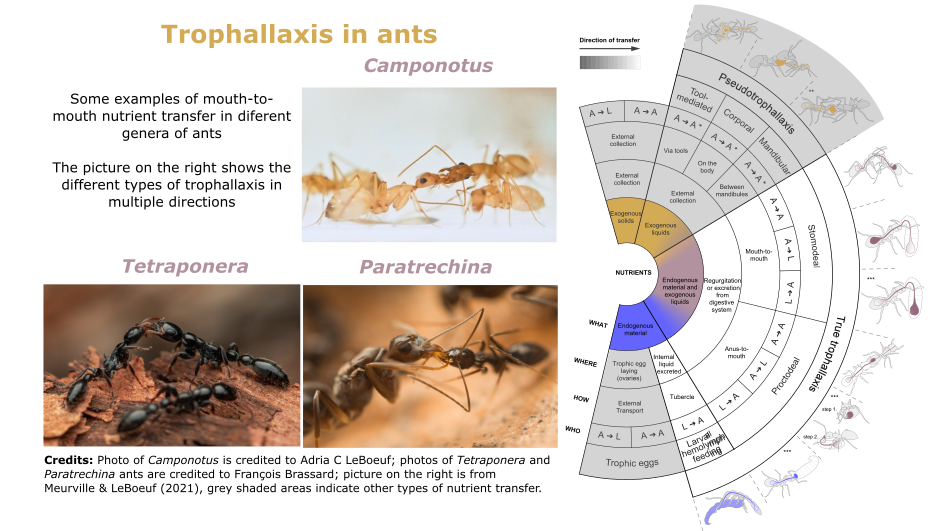
Ants are social insects, well known for their division of labor and caste systems, as well as their hardworking nature. They have also inspired popular culture, including sayings (“ants in your pants”), music (see “Ants marching” and “El hormiguero”), and jewelry. However, there is one curious behavior that is largely unknown to the general public (and even to many scientists) called trophallaxis, in which ants ingest liquid shared by another individual! This can occur in two different ways: as a regurgitate coming from the mouth, called stomodeal trophallaxis, or as an excretion from the rectal end of the abdomen, called proctodeal trophallaxis. Trophallaxis also occurs in earwigs, burying beetles, birds, and mammals, but we will focus on ants, an extensively studied group.
In a comprehensive review, Meurville & LeBoeuf (2021) describe how within ant colonies, trophallactic behavior occurs in multiple directions, including adult-to-adult, adult-to-larva, and larva-to-adult interactions. It even can occur with other organisms such as aphids, butterflies, and plants! The fluid that they socially exchange is a cocktail of microorganisms, proteins, nucleic acids, and small molecules. Proctodeal fluid may also include excretions from the Dufour’s gland and poison gland, as well as proteins from venom. Trophallaxis happens in different contexts such as during nourishment, decision-making, defense against pathogens, social maintenance, aggression (both within and between species), and the inoculation and maintenance of the gut microbiota.
Using an integrative approach that combined evolutionary and phylogenetic analyses with deep-learning tools, Meurville and colleagues (2025) inferred that trophallaxis evolved in two main events: first 130 million years ago (mya) in non-doryline formicoid ants and later, around 90 mya, in some ponerine ants. They identified a high number of gains and losses across the phylogeny, suggesting that social regurgitation is a highly plastic behavior. Its evolution was enabled by both the reduction of social conflict and the opportunistic inclusion of nectar and honeydew in the ant diet, which coincided with shifts toward flowering plants in terrestrial ecosystems.
Studying the macroevolutionary history of trophallaxis and its consequences is challenging, given that these types of behavior are not easily inferred from fossil evidence and are difficult to assess and quantify even in extant species. Nevertheless, further research is needed to determine the role of this social transfer in shaping the ecological success of one of the most dominant groups in the animal kingdom.
Meurville and LeBoeuf run an open-science database, “Trophallaxis behavior in ants”, which compiles known trophallactic behaviors across ant species. Please do contact them if you can contribute new observations!
Sources:
Meurville MP, Silvestro D & LeBoeuf AC. 2025.Ecological change and conflict reduction led to a social circulatory system in ants. Communications Biology 8:246. https://doi.org/10.1038/s42003-025-07688-7
Meurville MP & LeBoeuf AC. 2021. Trophallaxis: the functions and evolution of social fluid exchange in ant colonies (Hymenoptera: Formicidae). Myrmecological News 31: 1-30. https://doi.org/10.25849/myrmecol.news_031:001