IS THE HEALTH OF THE OFFSPRING REALLY ONLY THE MOTHER’S RESPONSIBILITY?
Decades of research have been dedicated to link the mother’s health and nutritional habits with the health of their children in both the short and the long term. And yes, it is important of course! However, what do we know about the effect of the father’s nutritional habits? Is the father’s only job really to contribute sperm to fertilize the egg? In short, the answers are “yes” and “no”. Yes, because the nutritional habits of the father also affect the offspring. And no, because the sperm does not only contribute genetic material, but also play a fundamental role in fetal and child development.
In an elegant review, Skerrett-Byrne and colleagues (2025) remind us that sperm is far from being only a passive DNA carrier, but rather is an epigenetically active player …
Decades of research have been dedicated to link the mother’s health and nutritional habits with the health of their children in both the short and the long term. And yes, it is important of course! However, what do we know about the effect of the father’s nutritional habits? Is the father’s only job really to contribute sperm to fertilize the egg? In short, the answers are “yes” and “no”. Yes, because the nutritional habits of the father also affect the offspring. And no, because the sperm does not only contribute genetic material, but also play a fundamental role in fetal and child development.
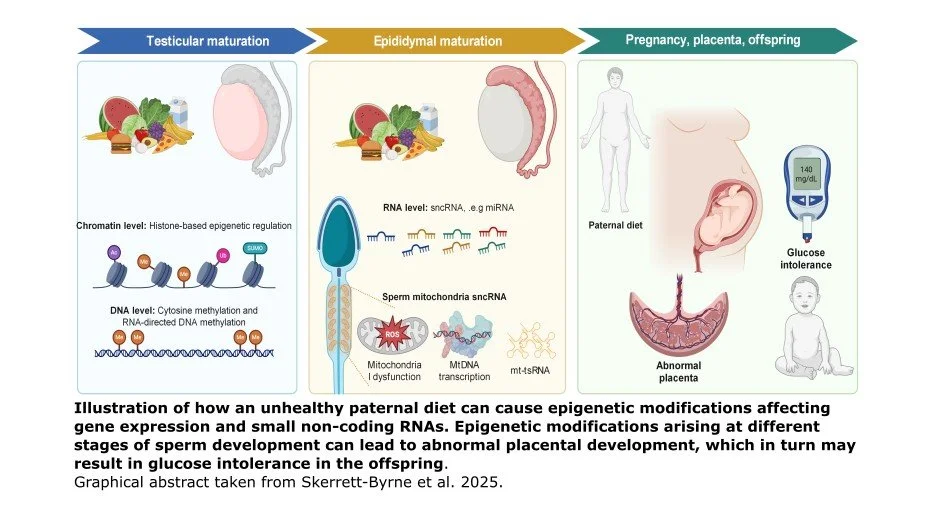
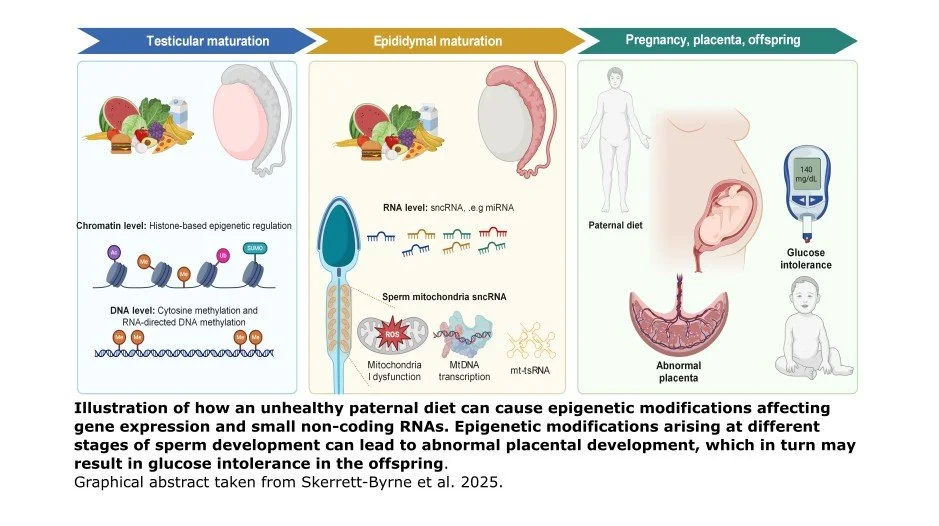
In an elegant review, Skerrett-Byrne and colleagues (2025) remind us that sperm is far from being only a passive DNA carrier, but rather is an epigenetically active player. The epigenome can be thought of as a set of chemical tags that dictate gene expression, turning different genes on and off. In their review, the researchers point out that sperm can acquire epigenetic information, driven by environmental and dietary stressors. They highlight evidence that shows how a high-fat-diet (HFD) causes epigenetic changes in fathers’ sperm that in turn alter the expression of genes and small non-coding RNAs. These changes are implicated in placental and embryonic development, as well as metabolic disease susceptibility in offspring after birth.
The review goes a step further by introducing an interactive digital application, ShinySpermPlacenta, designed to facilitate open-access exploration of the paternal epigenetic data. Users can explore the overlap between HFD sperm epigenetic data and placenta phenotype-driven genes. The app aims to promote systems-level understanding of how preconception environments shape the next generation.
Although the research on the transgenerational effects of paternal nutrition is still new compared to research on maternal nutrition, the growing body of evidence is substantial. Skerrett-Byrne and colleagues highlight the need to reframe preconception care as a truly bi-parental responsibility, rather than placing the entire burden on mothers. This fresh perspective could improve fertility and reduce pregnancy complications and chronic disease in our society.
Source:
Skerrett-Byrne DA, Pepin AS, Laurent K, Beckers J, Schneider R, de Angelis MH & Teperino R. 2025. Dad’s diet shapes the future: How paternal nutrition impacts placental development and childhood metabolic health. Molecular Nutrition & Food Research, 0:e70261. https://doi.org/10.1002/mnfr.70261
MILK PROVISIONING IN TSETSE FLIES
You probably have heard about the tsetse fly, the African fly which feeds on blood of both humans and animals. They are a troubling public health concern because they are vectors of African trypanosomes. However, tsetse flies are also known for something else - something extraordinary.
Similar to humans, tsetse flies possess milk glands! Mother flies give birth to live young, after larvae develop inside of their uterus. To nourish their larvae …
You probably have heard about the tsetse fly, the African fly which feeds on blood of both humans and animals. They are a troubling public health concern because they are vectors of African trypanosomes. However, tsetse flies are also known for something else - something extraordinary.
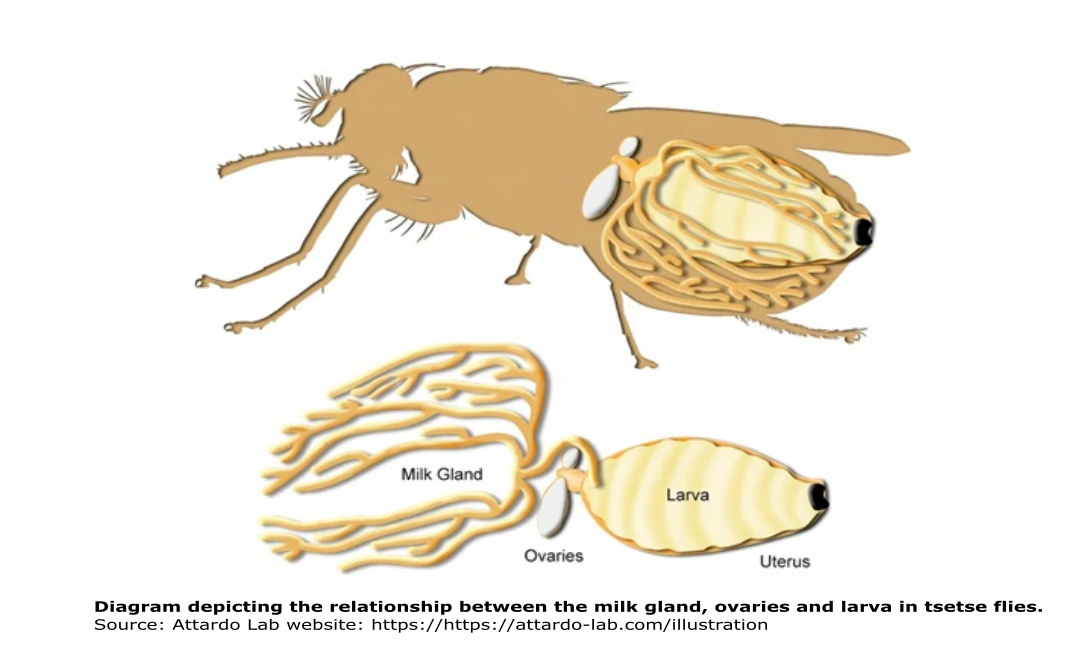
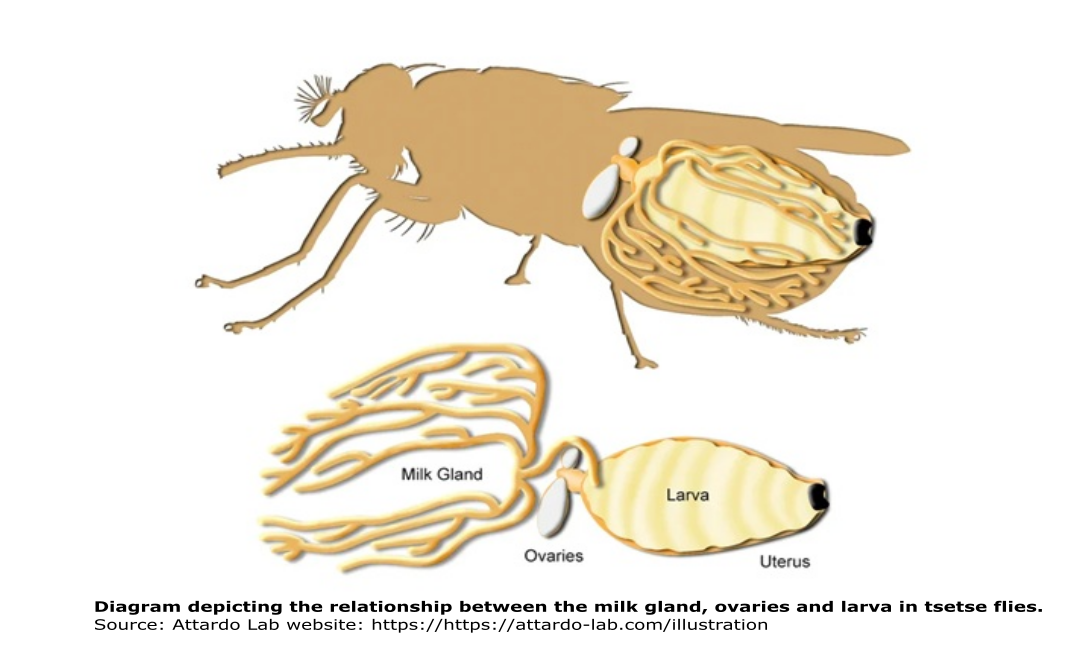
Similar to humans, tsetse flies possess milk glands! Mother flies give birth to live young, after larvae develop inside of their uterus. To nourish their larvae while in the uterus, female tsetse flies use a modified accessory milk gland, which provides proteins and lipids needed for larval development.
In a functional analysis study, Attardo and collaborators (2008) knocked down a milk protein in pregnant female tsetse flies to understand its function in larval nutrition. The knockdown group had a lower rate of pupal deposition relative to the control group in which synthesis of the milk protein was not disrupted. The results suggest that the protein plays an important role in larvigenesis, providing not only nutrition, but also important biochemical function as a carrier of lipid and/or sterol type molecules.
But there is more, a 2-for-1 on socially transferred materials! Along with the milk, mother flies also transmit some bacterial symbionts to their larvae. Balmand and collaborators (2013) found that some symbionts are maternally transferred via the milk glands. These symbionts colonize the lumen of the milk glands and are transferred to the larvae along with the milk. The microbes are important because they might affect the insect’s capacity to act as a vector of trypanosomes. Also, given the incomplete nutritional value of blood, the symbionts are essential in complementing milk to maintain the tsetse fly life cycle.
Watch this incredible video from KQED: https://www.kqed.org/science/1956004/a-tsetse-fly-births-one-enormous-milk-fed-baby
Sources:
Attardo GM, Lohs C, Heddi A, Alam UH, Yildirim S & Aksoy S. (2008). Analysis of milk gland structure and function in Glossina morsitans: Milk protein production, symbiont populations and fecundity. Journal of Insect Physiology 54, 1236–1242. doi.org/10.1016/j.jinsphys.2008.06.008
Balmand S, Lohs C, Aksoy S & Heddi A. (2013). Tissue distribution and transmission routes for the tsetse fly endosymbionts. Journal of Invertebrate Pathology 112, S116–S122. doi.org/10.1016/j.jip.2012.04.002
FEEDING ON SLIME
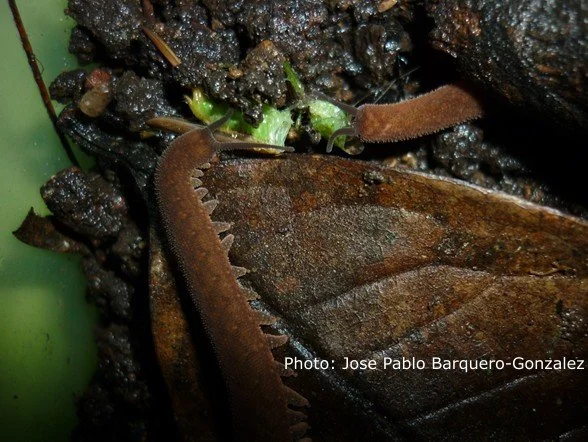
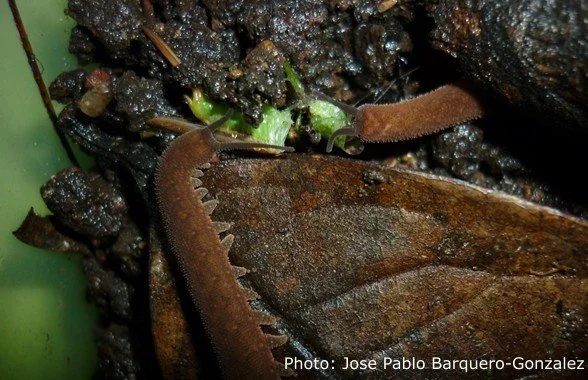
Velvet worms are among the most extraordinary animals on earth! With a very simple body structure, these ancient animals have been living on our planet for nearly 500 million years. Despite their name, they are not actually worms. They are not insects either, but look like caterpillars, and belong to their own phylum called Onycophora.
Onycophorans have a remarkable technique for hunting. To capture their prey, velvet worms eject a sticky, adhesive slime from their oral papillae, which are located close to their mouth. The sticky slime immobilizes the prey so that the velvet worm can then casually approach it.
In a study of feeding behavior conducted in Costa Rica in 2019, researchers documented for the first time a form of parental feeding in velvet worms...
Velvet worms are among the most extraordinary animals on earth! With a very simple body structure, these ancient animals have been living on our planet for nearly 500 million years. Despite their name, they are not actually worms. They are not insects either, but look like caterpillars, and belong to their own phylum called Onycophora.
Onycophorans have a remarkable technique for hunting. To capture their prey, velvet worms eject a sticky, adhesive slime from their oral papillae, which are located close to their mouth. The sticky slime immobilizes the prey so that the velvet worm can then casually approach it.
In a study of feeding behavior conducted in Costa Rica in 2019, researchers documented for the first time a form of parental feeding in velvet worms involving a socially transferred material. Barquero-Gonzales and colleagues showed that in some species, during the first two weeks after birth, the young only eat one thing: the threads of slime used by their parents to capture their prey! This is an unusual form of parental care, and noteworthy as an example of early evolution of a socially transferred material given how ancient these creatures are.
The slime is composed of proteins and lipids, and although its original function may have been defense and prey capture, the components of the slime also represent a good quality food source. So far this is the only study documenting this behavior in velvet worms, so more work is needed to understand the nutritional importance of slime feeding in young velvet worms.
Source: Barquero-González JP, Vega-Hidalgo A & Monge-Nájera J. (2019). Feeding behavior of Costa Rican velvet worms: food hiding, parental feeding investment and ontogenetic diet shift (Onychophora: Peripatidae). doi.org/10.22458/urj.v11i2.2195