AN OVIPAROUS CAECILIAN FEEDS ON OVIDUCTAL MILK
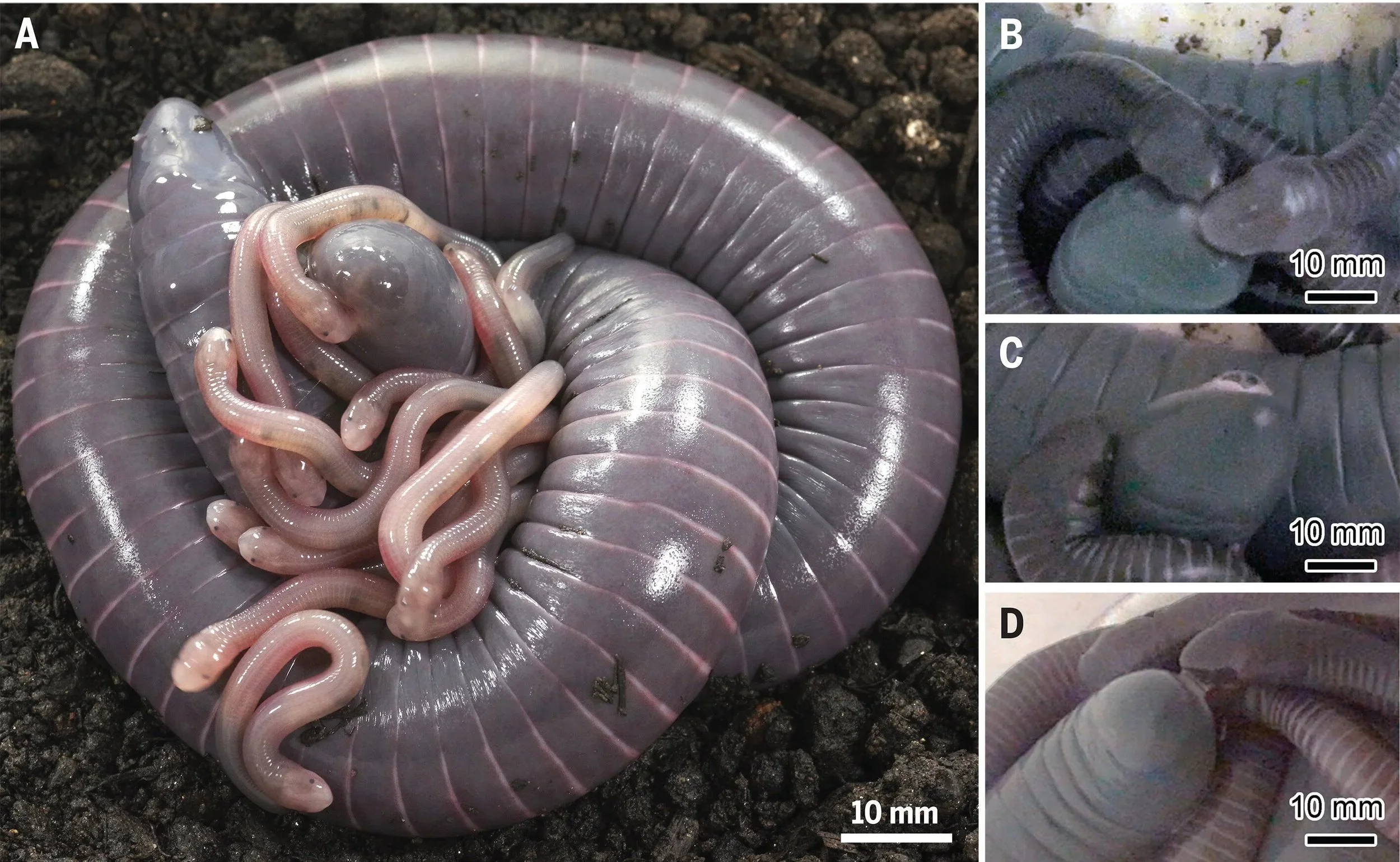
Figure taken from Mailho-Fontana et al. 2024 showing parental care behaviors of the Brazilian caecilian Siphonops annulatus. (A) The distal portion of the mother’s body remains elevated. (B) The hatchlings often show interest in the maternal vent by touching or nibbling on it. (C) Milk being released after stimulation. (D) Milk consumption by one young individual.
When you think about amphibians, caecilians are probably not the first animals that come to mind. They are among the most poorly understood amphibians, largely due to their fossorial lifestyle. Classified in the order Gymnophiona, they differ from frogs and salamanders because they are limbless and elongated, resembling snakes or worms more than a “typical” amphibian. Despite their secretive nature, researchers have documented interesting parental feeding mechanisms, such as nourishment within the oviducts in live-bearing species and skin feeding in oviparous species.
However, this fascinating group keeps surprising us with more forms of parental feeding. Recently, Mailho-Fontana et al. (2024) documented milk provisioning in the Brazilian oviparous caecilian Siphonops annulatus. The mothers exude a secretion from the vent, where the hatchlings gather and feed. It seems like the hatchlings stimulate the female both through physical contact -– touching the vent with their snouts or nibbling – and through high-pitched vocalizations.
Besides milk provisioning, this species also exhibits skin feeding, first described in 2008 by Wilkinson and colleagues. However, this behavior appears to be less frequent, occurring weekly, while milk is provided daily. Milk is clearly important for the nutrition of the young.
But, the researchers did not stop there! They also found that the milk originates from the oviductal lumen and glands that develop from hypertrophied oviductal epithelial cells during the parental care phase. Using histological and chemical analyses, the researchers identified that the milk is composed of neutral glycoconjugates and lipids, a composition similar to the nutritive fluid found in the oviducts of live-bearing caecilians.
Mailho-Fontana et al. (2024) emphasize the importance of integrative studies that join together fieldwork, life history, behavior, and morphology when dealing with animals that have fossorial lifestyles. Something remarkable about their finding is that it is the first time that oviductal milk production has been documented in an oviparous amphibian, which exemplifies the complexity of the evolution of reproductive modes in vertebrates.
The article’s supplementary material (https://doi.org/10.1126/science.adi5379) includes fascinating videos that clearly show the release of milk from the maternal vent and the feeding behavior of the hatchlings.
Source:
Mailho-Fontana PL, Antoniazzi MM, Coelho GR, Pimenta DC, Fernandes LP, Kupfer A ED Brodie Jr, Jared C. (2024). Milk provisioning in oviparous caecilian amphibians. Science 383, 1092–1095. https://doi.org/10.1126/science.adi5379