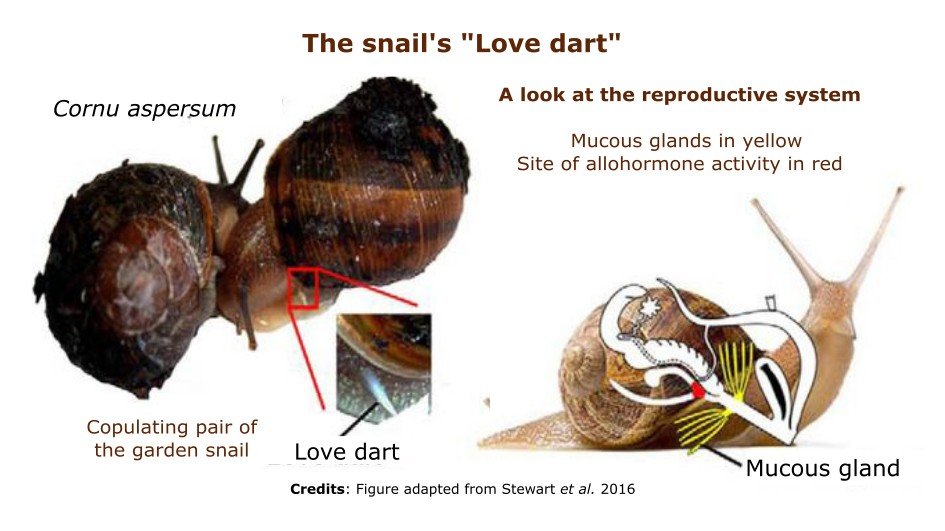
THE SNAIL’S LOVE DART
When we talk about competition for mates, we often think of behaviors involving tense fights or flamboyant displays of traits that signal quality. However, sometimes the competition continues even after mating, as the sperm must outcompete sperm from other mates.
In land snails of the families Helicidae and Ariophantidae, this post-copulatory competition involves the injection of a calcium-based “love dart”. These snails are simultaneous hermaphrodites, so during mating, both partners can act as male and female, leading to …
When we talk about competition for mates, we often think of behaviors involving tense fights or flamboyant displays of traits that signal quality. However, sometimes the competition continues even after mating, as the sperm must outcompete sperm from other mates.
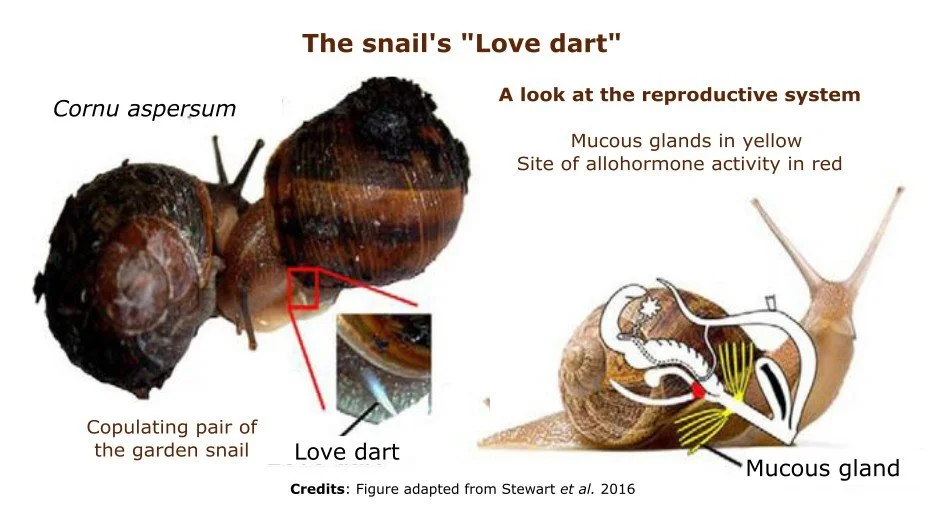
In land snails of the families Helicidae and Ariophantidae, this post-copulatory competition involves the injection of a calcium-based “love dart”. These snails are simultaneous hermaphrodites, so during mating, both partners can act as male and female, leading to competition over paternity. Shooting the dart forms part of the courtship ritual, in hopes of increasing the shooter’s success at paternity. The love dart is coated with sticky mucus from a gland located near the dart sac.
Using an integrative approach, Stewart and colleagues (2016) showed that the mucus of the garden snail Cornu aspersum contains a bioactive substance, dubbed the “love dart allohormone” (LDA). When the LDA is transferred to the mating partner, it induces physiological changes in the female reproductive system that reduce digestion of sperm. This socially transferred material increases the chances that the shooter’s sperm will be used for fertilization, thereby enhancing paternity success.
The study also identified numerous additional peptides in the dart mucus that may influence the mating behavior of recipient snails. Further research is needed to disentangle the functions of these peptides, as well as other LDA precursor molecules. Future work on this topic will advance our understanding of the evolution of accessory glands and their products as well as alternative reproductive strategies.
Source:
Stewart M, Wang T, Koene J, Storey KB & Cummins SF. 2016. A “Love” Dart Allohormone Identified in the Mucous Glands of Hermaphroditic Land Snails. Journal of Biological Chemistry 291:7938-7950. https://doi.org/10.1074/jbc.M115.704395