TOXIC SEX: WHEN POISON BECOMES A GIFT
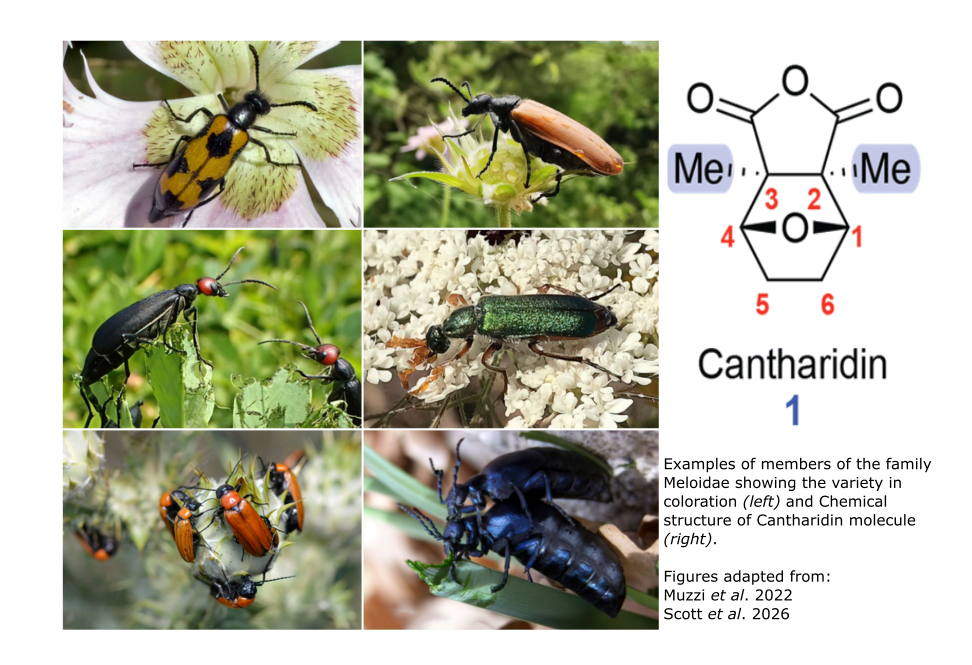
Blister beetles, as their name suggests, are beetles of the Meloidae family known for causing blisters upon contact with human skin. Toxicity in these coleopterans is due to the presence of a defensive chemical compound in their hemolymph called cantharidin, which is known to be toxic to mammals, birds, and frogs. Cantharidin has fascinated scientists and human societies alike for centuries and has a long history in both scientific and popular literature.
Female blister beetles contain less cantharidin than males. They are unable to synthesize it themselves, but the way that they acquire it is fascinating: they…
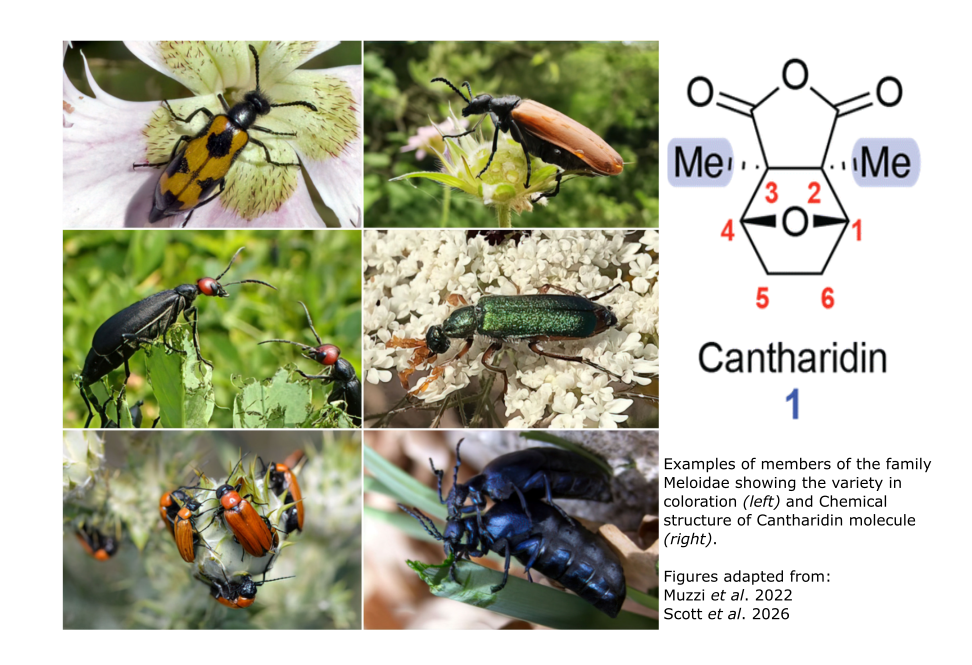
Blister beetles, as their name suggests, are beetles of the Meloidae family known for causing blisters upon contact with human skin. Toxicity in these coleopterans is due to the presence of a defensive chemical compound in their hemolymph called cantharidin, which is known to be toxic to mammals, birds, and frogs. Cantharidin has fascinated scientists and human societies alike for centuries and has a long history in both scientific and popular literature.
Female blister beetles contain less cantharidin than males. They are unable to synthesize it themselves, but the way that they acquire it is fascinating: they receive it from males! Cantharidin is synthesized in the accessory reproductive glands of male blister beetles. The males incorporate it into the spermatophore, and then it is transferred as a nuptial gift during copulation. Females then absorb the cantharidin and incorporate it into their bodies, thereby achieving chemical defense.
Another extraordinary aspect of this process is that females accumulate cantharidin in their ovaries and add it to their eggs. Therefore, blister beetle eggs are also chemically protected against predation. This system is particularly interesting because it is a case in which the same material is socially transferred in two different contexts: from male to female during mating and from female to eggs during maternal provisioning.
In human society, cantharidin has been known for over 2000 years. It has been used in traditional medicine and pharmacology in a multitude of cultures and countries, as an aphrodisiac, a drug, and even a poison. Derivatives of cantharidin are currently being investigated as therapeutic alternatives due to their strong potential as novel anticancer agents. Cantharidin itself was recently approved by the FDA (as a topical solution called “YCANTH”) to treat molluscum contagiosum. The blister beetle-cantharidin system is a great example of how one can derive useful benefits, here in a medical context, from the wonders of nature and the powers of Socially Transferred Materials.
Recommended literature:
McCormick JP, Carrel JE, 1987. Cantharidin biosynthesis and function in meloid beetles. In: Prestwitch, GD, Blomquist, GJ. (Eds.), Pheromone Biochemistry. Academic Press, Orlando, FL, pp. 307–350. https://doi.org/10.1016/B978-0-12-564485-3.50015-4
Muzzi M, Mancini E, Fratini E, Cervelli M , Gasperi T, Mariottini P, Persichini T, Bologna MA & Di Giulio, A. 2022. Male Accessory Glands of Blister Beetles and Cantharidin Release: A Comparative Ultrastructural Analysis. Insects 13, 132. https://doi.org/10.3390/insects13020132
Scott KA, McCluskey A, Njardarson JT & Wang W. 2026.On the history, synthesis, and medicinal use of cantharidin, LB-100, and their analogs. Royal Society of Chemistry Medical Chemistry 17, 743–767. https://doi.org/10.1039/d5md00917k
Sierra JR, Woggon WD, Schmidt H, 1976. Transfer of cantharidin during copulation from the adult male to the female Lytta vesicatoria (Spanish flies). Experientia 32, 142–144. https://doi.org/10.1007/BF01937729